

Top 10 Style AI Prompts for Men’s Distinct Fashion Statements and Personal Aesthetics
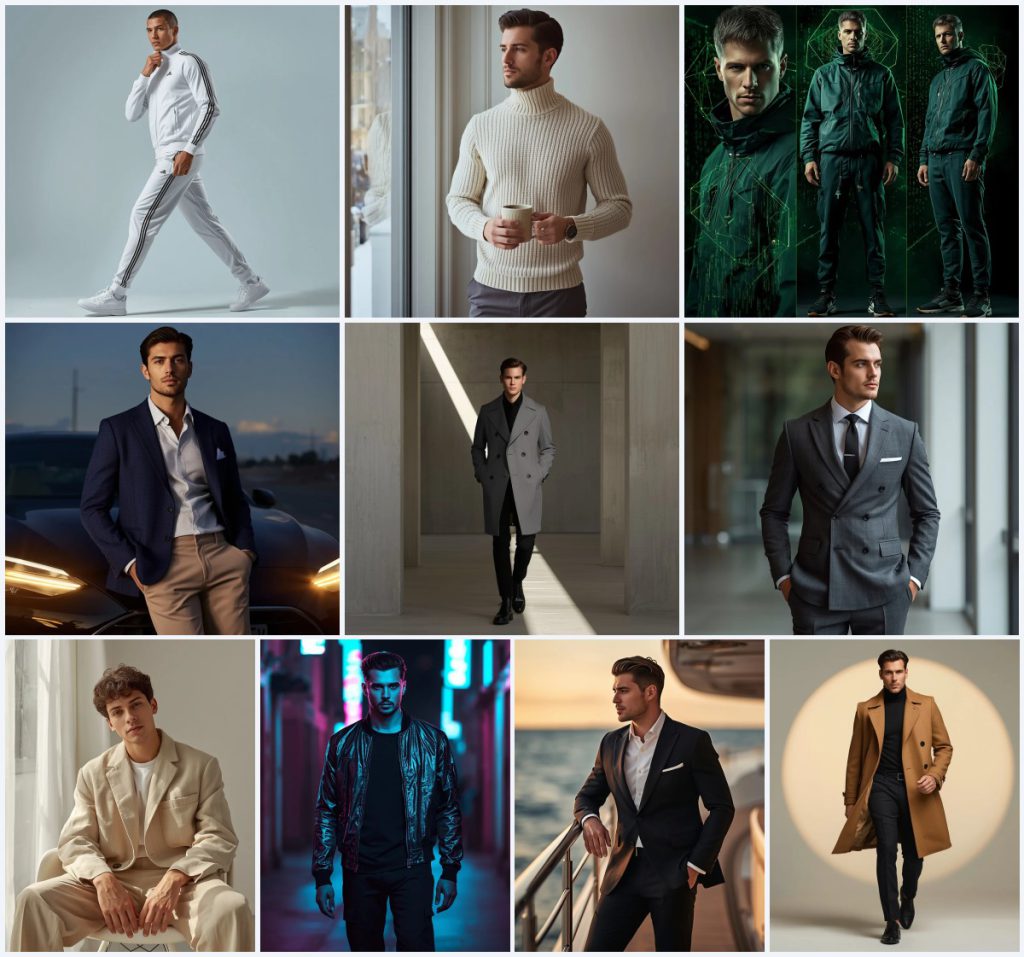
This collection gathers ten men's style AI prompts that each build a different personal aesthetic, from a clean white designer tracksuit to a camel cashmere trench coat. Every card is a full-body portrait with its own location, light, and pose, so you can pick the mood you want before you open an image generator.
The set is useful because the prompts describe clothing texture, posture, and background in plain language. That makes them easy to reuse with a reference photo and easy to adjust when a face, a hand, or a fabric fold comes out wrong.
What this men's style prompt collection is asking for
Across the ten cards, the shared request is a sharp, full-body male portrait where the outfit leads the story. Some cards place the man in a studio, others on a neon street, a corporate lobby, or a yacht deck, but each one keeps the clothing and the lighting as the main subject. The prompts read like art direction rather than a list of random adjectives, which is why they hold together well in a single generation.
- A clean white designer tracksuit with minimalist black stripe details
- A heavily textured cream knit turtleneck sweater held with a warm mug
- A high-collar waterproof jacket, tactical pants, and modern sneakers in a data-code collage
- A navy blue textured blazer worn against a sleek car at dusk
- A long slate grey designer trench coat in a minimalist architectural space
- A camel-colored cashmere coat over a black fitted turtleneck and black tailored trousers
The scenes these style cards build
Each card sets a clear stage. The athletic man steps forward "in a sharp cross-step, with one hand adjusting his collar" against "a clean, modern concrete wall with a soft pastel blue shadow gradient." The turtleneck card slows everything down: the man stands "by a large window on a chilly day" and looks "thoughtfully out the window with a calm, masculine expression."
The evening cards lean on contrast. The blazer portrait places the man "leaning against a sleek modern car at dusk," where "the cool twilight sky contrasts with the warm golden headlights of the car." The cyberpunk card moves to "a neon-lit futuristic street" with "cool cinematic pink and blue neon lights illuminating his face." The yacht card ends the set in "a soft-focused sea with warm gold and orange pastel sky gradients."
Why these prompts work for men's fashion portraits
These cards work because they solve the three problems that usually ruin a men's style image: the outfit loses detail, the pose looks stiff, and the background competes with the subject.
- Fabric is named with real texture, such as the "realistic wrinkled texture of the linen fabric" or the "rich, soft texture of the cashmere coat," so the model has something specific to render.
- The pose is described as an action, like "stepping forward in a sharp cross-step" or "walking forward, his coat left open," which prevents the frozen mannequin look.
- The background is controlled with simple geometry and light, such as "a clean, modern studio with a soft beige gradient spotlight," so the face stays the focal point.
Three style directions inside this set
The collection holds three clear style directions, and each one stays inside the prompt text rather than borrowing from outside trends. Choose one before you generate so the outfit, light, and location agree with each other.
- High-fashion activewear: The white tracksuit card uses high-contrast studio lighting and a pastel blue shadow gradient to create a viral activewear look.
- Cinematic cyber-chic: The holographic jacket card uses pink and blue neon lights, a slightly blurred background, and ultra-realistic 8k resolution for a street-style portrait.
- Editorial luxury: The tuxedo yacht card and the camel cashmere card both use golden or beige light to keep the fabric premium and the mood sophisticated.
How to run these prompts step by step
Pick one card first, because mixing two outfits in one generation usually muddies the fabric and the pose. Then follow the same short routine for every card in the set.
- Copy the prompt. Copy the full card text, including the pose, the background, and the lighting clause, because those three parts control the realism.
- Upload a reference. Upload a clear, well-lit photo of the person you want, ideally full body and without heavy shadows on the face.
- Generate. Run the prompt at a high resolution setting and generate at least four variations before you judge the result.
- Check the hands. Look at the hand adjusting the collar or resting in a pocket, since fingers are the most common failure in these poses.
- Check the face. Confirm the expression matches the card, such as "confident and focused" or "calm and effortless," and that the eyes are symmetrical.
- Check the main object. Inspect the outfit or the prop, such as the warm mug, the chrome railing, or the coat buttons, and regenerate if the texture is flat.
Choosing the reference photo
A good reference photo does most of the work for these prompts, because the model copies posture and proportion from it as much as it copies the face.
- Use a full-body or three-quarter shot so the generator can read your height and shoulder line, which matters for the walking and leaning poses.
- Use soft, even daylight on the face, because hard side light will fight the studio and dusk lighting described in the cards.
- Keep the background plain and the clothing simple, so the white tracksuit or the camel coat replaces your clothes cleanly instead of blending with them.
Tools that handle these prompts well
Any modern image generator can run these cards, but they differ in how well they hold fabric texture and facial likeness. The table below matches each tool to a real detail from this set.
| Tool | Access | Typical realism | Useful here for |
|---|---|---|---|
| ChatGPT | Free and paid tiers | Good for planning and moderate image realism | Rewriting the white tracksuit card into a shorter prompt and checking that the black stripe details survive. |
| Google Gemini | Free tier available | Strong on text understanding, variable on faces | Adapting the corporate lobby suit card and keeping the double-breasted cut and black silk tie intact. |
| Leonardo AI | Free daily credits | High realism with good fabric rendering | Rendering the heavily textured cream knit turtleneck sweater and the warm mug in natural window light. |
| Midjourney | Paid subscription | Very high realism and cinematic light | Producing the neon-lit futuristic street with pink and blue lights on the holographic jacket. |
Practical tips for cleaner men's style images
Small changes to the prompt text often fix the biggest realism problems. These three tips all point back to objects and materials that already appear in the cards.
- For the camel cashmere coat, add a line asking for visible fiber softness, because plain wording often turns cashmere into flat wool.
- For the turtleneck card, keep the warm mug in the prompt but ask for both hands visible, since a hidden hand is where generators usually break.
- For the slate grey trench coat, mention the concrete structure and the sharp beam of sunlight again, because that contrast is what makes the coat read as designer rather than generic.
Common failures and what to change
These cards are detailed, but they can still fail in predictable ways. Use the table to match the problem to a single change before you regenerate.
| Issue | What to change |
|---|---|
| Fingers merge on the hand adjusting the collar | Add a clause asking for relaxed, clearly separated fingers, or change the pose to one hand in a pocket. |
| The face drifts from the reference photo | Lower the stylization setting and upload a sharper reference, then repeat the expression wording from the card. |
| The knit or linen texture looks plastic | Name the material again in the prompt and add a request for visible weave or wrinkle detail in natural light. |
| The background overpowers the subject | Reduce the background detail, keep the gradient or the blurred city signs, and ask for a shallow depth of field. |
Frequently Asked Questions
Can I use one of these men's style AI prompts without a reference photo?
Yes. The cards are written to work from text alone, but results improve a lot when you upload a full-body reference, especially for the walking poses and the fitted suits.
Which card in this set is best for a professional profile picture?
The charcoal grey double-breasted suit card is the safest choice, because the corporate lobby, the soft natural lighting, and the upright posture all read as professional.
How do I keep the outfit exact when I change the background?
Keep the clothing sentence untouched and edit only the background clause, then regenerate at high resolution so the fabric texture and the original light direction stay consistent.
Conclusion
These ten men's style AI prompts cover a wide range of personal aesthetics, from a white designer tracksuit to a camel cashmere coat, and each one gives the generator enough detail to build a believable full-body portrait. Start with the card that matches your mood, run several variations, and check the hands, face, and main object before you settle on a final image.
Edit only photos you have the right to edit, and credit the people whose likeness or reference images you use.