

New 10 Concert Couple AI Prompts for Romantic Slow Dances with Ethereal Lighting
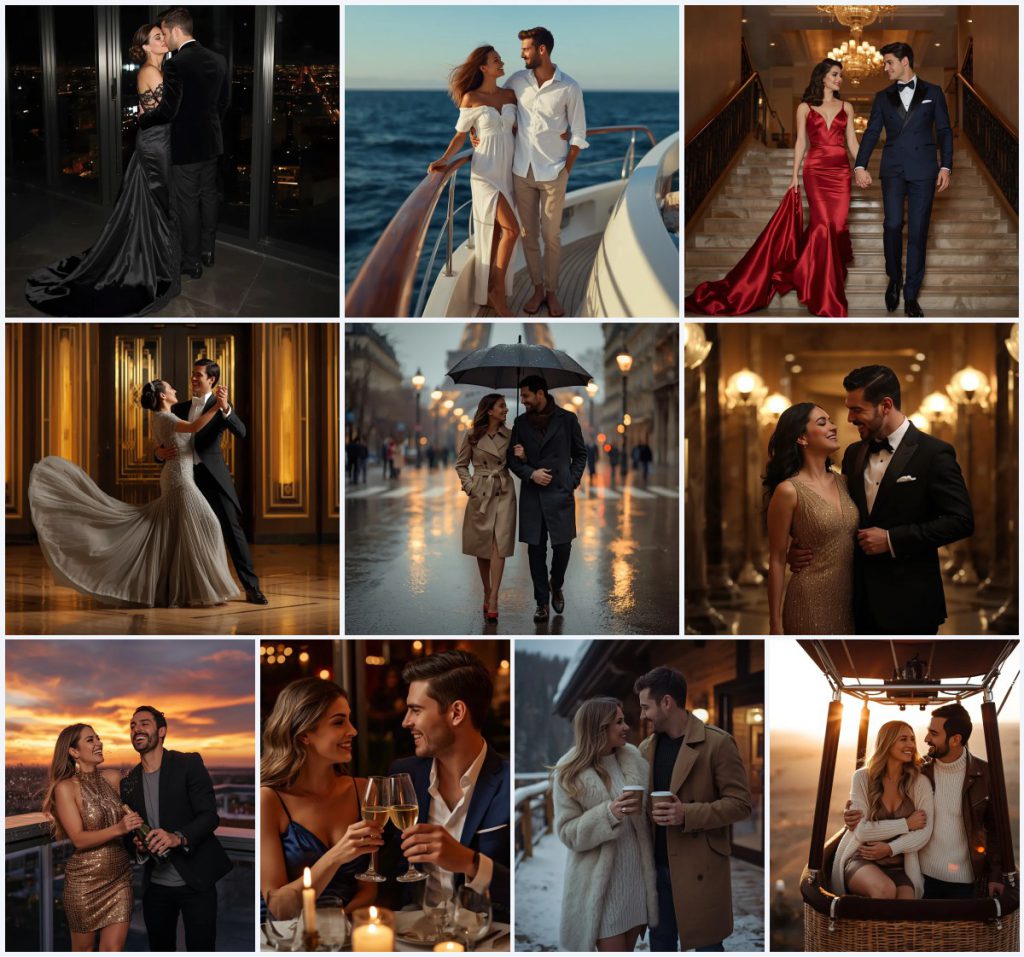
This set gathers ten separate couple prompts that all lean on the same idea: two people caught mid-moment while light does most of the storytelling. The titles range from a black-tie gala and a yacht deck in white linen to a marble staircase, an Art Deco ballroom, a rainy Paris street, a rooftop champagne toast, a candlelit dinner, a snowy terrace, and a sunrise hot air balloon. Each one is written for a still image, not a video, so the romance has to arrive in a single frame.
The shared scene is a slow, suspended beat: a hand on a waist, an umbrella overhead, glasses touching, a lean into an arm. Ethereal lighting shows up as chandelier glow, golden hour, candle flicker, and wet-street reflections rather than any concert stage. If you have ever tried to make two people look genuinely close in an AI image, you already know the hard part is not the dress. It is the hands, the eyes, and the light landing on both faces at once.
What these couple prompts are actually asking for
Every prompt in this set describes two adults, full outfits, a location, and a lighting mood in one pass. The wording is specific about fabric and pose because those are the details that keep a generated couple from looking like two strangers pasted together. The prompts also name a camera feel, such as full-body, half-body, or shallow depth of field, which controls how much of the room you actually see.
- Two clearly described outfits, such as a black silk gown with a long train beside a black velvet blazer, or a beige trench coat beside a dark grey wool trench.
- A named location, including a glass window over a city skyline, a yacht deck, a grand marble staircase, an Art Deco ballroom, a wet Parisian street, a rooftop bar, a candlelit table, a snowy terrace, and a wicker balloon basket.
- A physical pose that ties the pair together, like holding hands, an arm around a shoulder, a hand on a waist, or walking under one umbrella.
- A light source tied to the place, such as a grand chandelier, vintage lamps, candle flicker, golden hour clouds, or warm cabin light.
- A stated camera framing, including full-body, half-body, mid-spin, and shallow depth of field.
- Small motion cues, such as hair blowing in the sea breeze, a satin train sweeping, or champagne bubbles frozen mid-air.
The slow-dance mood inside each frame
The set reads like a short film shot list. One prompt places the pair "mid-spin, his hand holding her waist as she leans back gracefully," which gives the image a direction of movement instead of a stiff pose. Another puts them "walking close under a single black umbrella, sharing a private laugh as she leans into his arm," and the umbrella becomes the frame inside the frame. A third keeps them still at a table, "clinking crystal wine glasses while looking into each other's eyes," so the intimacy comes from eye contact rather than motion.
The lighting changes the temperature of each scene. Warm chandelier light on satin reads as old-money elegance, while "the streetlights reflect off the wet asphalt" turns the same couple into something softer and more cinematic. On the rooftop, "soft white bubbles frozen mid-air" adds energy. On the snowy terrace, "soft golden light glowing from the cabin behind them" makes cold air feel comfortable. None of these are concert lights, yet all of them behave like stage light on two people.
Why this collection works for romantic couple images
The value here is that each prompt solves a different problem while keeping the same emotional target. You get variety without losing the thread.
- The prompts pair a clear pose with a clear light source, which is the fastest way to get two faces lit evenly instead of one person glowing and the other in shadow.
- Each entry names real clothing textures, such as silk, velvet, satin, linen, sequins, and faux fur, and texture is what makes an AI image read as a photograph rather than a render.
- The locations are ordinary enough to be believable but styled enough to look aspirational, so the results suit anniversary posts, save-the-date cards, and romantic wall art.
Three looks you can pull from this set
You can push these prompts in three directions without leaving the set. Each style below stays inside the wardrobe, locations, and lighting already written above, so you are reweighting the prompt rather than replacing it.
- Cinematic editorial: Lean on the gala, staircase, and Art Deco ballroom prompts, keep the chandelier and warm light wording, and ask for a slightly wider frame so the marble columns and geometric details stay visible.
- Rainy street romance: Use the Paris walk and the wet-asphalt reflection, keep the single black umbrella and the trench coats, and let the blurred Eiffel Tower sit far enough back that the couple stays the subject.
- Warm celebration: Follow the rooftop bar and candlelit dinner prompts, keep the champagne bubbles and crystal glasses, and hold the golden hour or candle flicker so both faces stay warm rather than orange.
How to run any of these prompts
Pick the card that matches the photo you already own, then work in short passes instead of rewriting everything at once. Small edits to pose and light beat big edits to the whole scene.
- Copy the prompt. Copy the full text of one card, such as the yacht deck or the candlelit dinner, and keep the outfit and lighting sentences intact for the first run.
- Upload a reference. Upload one clear photo of the two of you, ideally a full-body or half-body shot with both faces visible and no heavy shadows across either face.
- Generate. Run the prompt once without changes so you can see what the model does with the pose, the framing, and the light before you start adjusting.
- Check hands. Zoom in on every hand, since holding hands, a hand on a waist, and a hand around a shoulder are exactly where fingers merge or multiply.
- Check faces. Look at both faces at full size for eye direction, smile shape, and skin tone, and confirm the light source in the prompt is hitting both people evenly.
- Check the main object. Inspect the hero object in that card, whether it is the champagne bottle, the crystal wine glasses, the umbrella, or the wicker basket, and regenerate if it warps.
Choosing the reference photo
The reference does more work than the prompt in couple images, because it decides the faces and the body proportions. A clean, evenly lit photo gives the model less to guess about.
- Use a photo where both of you are facing the camera or turned only slightly, so the model has enough of each face to work with.
- Avoid harsh overhead light or strong side shadows, since the prompts already specify soft chandelier, candle, or golden hour light and the two will fight each other.
- Pick a shot with a simple background, because busy backgrounds confuse the model when it tries to rebuild a marble staircase, a wet street, or a rooftop skyline.
Which tool to use for these prompts
All four tools below can run these prompts, but they differ in how much control you get over two faces in one frame. Test the same card in two tools and compare the hands before you commit.
| Tool | Access | Typical realism | Useful here for |
|---|---|---|---|
| ChatGPT | Web and app, paid tiers for image generation | Good to very good on people, softer on fine fabric | Rewriting a card into a shorter prompt and keeping the black velvet blazer and tailored trousers consistent across tries. |
| Google Gemini | Web and app, free tier plus paid plans | Good on lighting and color, mixed on hands | Testing the warm golden light from vintage lamps in the Art Deco lobby card before you commit to a final render. |
| Leonardo AI | Web, free credits plus paid plans | Strong on cinematic light and texture | Rendering the streetlights reflecting off wet asphalt in the Paris walk card with a real photographic feel. |
| Midjourney | Web and Discord, paid plans | Highest overall polish on fabric and atmosphere | Getting the silver beaded gown to sweep mid-spin in the Art Deco ballroom card without losing the couple's faces. |
Small fixes that raise the realism
Most of the gains come from protecting the objects the prompt already names. If a prop or a garment reads wrong, the whole image feels generated.
- Keep the crystal wine glasses in the candlelit dinner card perfectly round, since curved glass is a common failure point and a warped rim kills the mood.
- Watch the champagne bottle and the frozen bubbles on the rooftop card, because a misshapen bottle or clumped bubbles look like a rendering error rather than a celebration.
- Give the silver beaded gown and the sweeping satin train enough room in the frame, since heavy fabric needs space to read as fabric instead of a flat shape.
Common problems and what to change
These are the failures this specific set tends to produce, along with the smallest edit that usually fixes each one.
| Issue | What to change |
|---|---|
| The couple looks like two separate people standing near each other | Restate the physical link from the card, such as the arm around the shoulder or the hand on the waist, and ask for a single shared light source. |
| Fingers merge where hands meet or where a hand grips the umbrella | Simplify the pose to one clear contact point, then regenerate and inspect the hand at full zoom before judging the rest of the image. |
| One face is bright and the other is in shadow | Name the light direction explicitly, using the chandelier above, the candle on the table, or the sunset behind them, and ask for even coverage on both faces. |
| The long satin train or the beaded gown turns into a shapeless mass | Widen the framing to full-body, keep the train wording, and reduce competing background detail so the fabric reads as fabric. |
Frequently Asked Questions
Can I use one of these prompts if my reference photo was taken indoors?
Yes. The prompt supplies the location and the light, so an indoor reference mostly affects the faces and the body proportions. Choose a card whose pose is close to your original shot, then let the prompt rebuild the setting around you.
Which card is easiest for a first attempt?
The candlelit dinner and the Art Deco lobby are the most forgiving, because both are half-body or shallow depth of field scenes with simple poses. The Art Deco ballroom mid-spin is the hardest, since motion plus a long train plus two faces is a lot to hold at once.
Do I need to keep the exact outfit words?
Keep them for the first run so you can see the intended look, then swap individual pieces if you want. Changing the black velvet blazer to a plain dark jacket is fine, but removing all texture words usually makes the result look flat.
Conclusion
This collection gives you ten ways to photograph the same feeling: two people close together while the light does the rest. Start with the card that matches a photo you already love, run it once untouched, then fix the hands, the faces, and the hero object in that order. The ethereal lighting is the reward, not the starting point, so get the pose and the contact right first and the glow will follow.
Edit only the photos you have the right to edit, and keep a copy of the original safe.