

Top 10 Saree with Statement Blouse AI Prompts for Fashion-Forward Styling
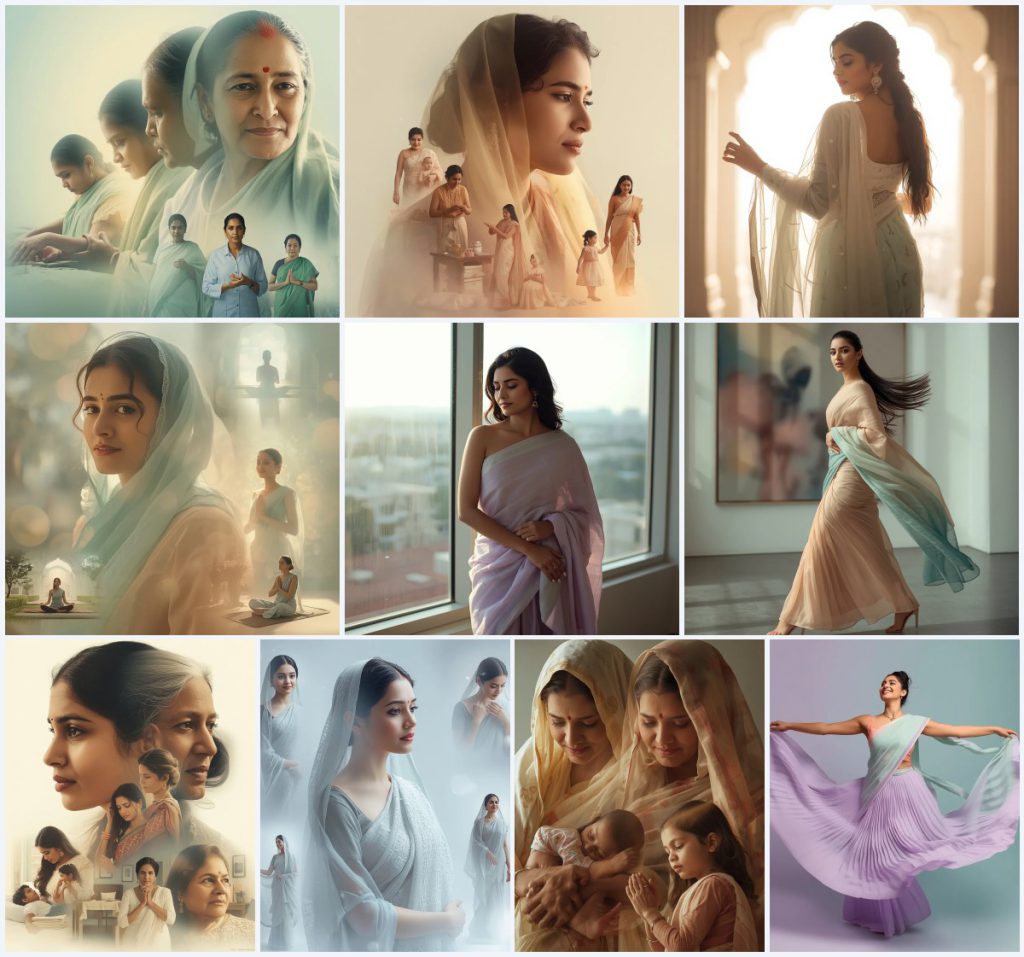
This collection gathers ten AI image prompts built around sarees and the blouses that finish them. Each prompt is a full scene, not just a clothing description, so the blouse reads as part of a pose, a light source, and a mood. The set moves from narrative life-stage compositions to clean studio-style twirls, which means you can test very different drapes without leaving the same visual world.
The shared thread is pastel color and soft, controlled light. Aqua, rose gold, cream, lavender, silver, peach, teal, charcoal, lilac, and mint appear across the cards, often in sheer chiffon, linen, georgette, or ombré fabric. If you want fashion-forward saree images that still look like photographs rather than costume catalog pages, this set gives you enough variety to compare results side by side.
What this saree and statement blouse prompt set is asking for
The prompts ask for Indian women in carefully specified sarees, captured in poses that let the blouse and pallu do visible work. Some cards are narrative collages with transparent, overlapping life stages, while others are single full-body portraits. In every case the clothing is described with enough precision that the model has to decide how a blouse sits at the shoulder, how the pallu falls, and how light travels across the fabric.
- Pastel sarees in aqua, rose gold, lavender, silver, peach, teal, charcoal, cream, lilac, and mint
- Statement blouses implied by the drape, shoulder line, and visible waist fit
- Sheer chiffon, linen, georgette, and ombré fabrics with distinct textures
- Backlit silhouettes at archways and sunlit windows with diffused light
- Overlapping narrative instances of the same woman across life stages
- Full-body poses with raised arms, folded hands, or a dynamic twirl
The scene inside these saree prompts
The settings are quiet and intentional. One card places the woman "at the threshold of a grand archway, silhouetted against a brilliant, diffused light source," while another sets her "beside a large, sunlit window" with her gaze directed downward. A third puts her in motion "across a contemporary art gallery," which changes the blouse from a still garment into something that has to hold its shape during a stride.
The narrative cards are more layered. They call for "transparent, overlapping instances of her life," so the frame contains a young face, mature hands, and wise eyes at the same time. The blouse and saree must stay consistent across those overlaps, which is the real challenge. When the prompt says "soft unified pastel tones, warm homely lighting," it is asking for one coherent light across several time layers.
Why this prompt collection works for fashion-forward saree images
These prompts are useful because they treat the saree as a photographic subject, not a flat product. The fabric descriptions, the pose instructions, and the light sources all push the model toward a real photograph with depth.
- The pastel palette keeps attention on drape, texture, and blouse fit instead of loud color
- Pose variety from backlit back views to twirls tests how well the blouse and pallu hold shape
- Narrative overlaps create emotional images that still show clothing clearly
Three styles living inside this prompt set
Three styles are already written into the cards, so you do not need to invent a new look. Each one changes how the blouse and saree read on camera.
- Ethereal backlit portrait: The archway card uses a brilliant diffused light source and a sheer pastel chiffon saree to create a glowing silhouette.
- Emotional narrative collage: The mother and healer cards overlap transparent life stages in one frame with soft unified pastel tones.
- Dynamic movement fashion shot: The twirling card uses a pastel georgette saree and a clean diffused backdrop to freeze motion.
How to run these saree prompts step by step
Work through the set one card at a time so you can judge each drape and blouse shape separately. The steps below keep the process repeatable.
- Copy the prompt. Take the full card text exactly as written, including the pastel color names and pose instructions.
- Upload a reference. Add your own saree or blouse photo if the tool accepts one, so the drape and fit stay close to real fabric.
- Generate the first pass. Run the prompt without edits and check whether the scene matches the archway, window, gallery, or narrative overlap.
- Check hands and face. Look at folded hands, raised arms, and facial expression, since these are the most common failure points.
- Check the main object. Confirm the saree pallu and blouse read as separate garments with correct pleats and shoulder line.
- Refine and rerun. Adjust only the failing clause, then generate again rather than rewriting the whole prompt.
Choosing a reference photo for these saree prompts
A good reference photo gives the model real information about fabric fall and blouse fit. It does not need to be professional, but it should be clear.
- Use even, natural light so pastel colors like aqua, lavender, and rose gold stay accurate
- Show the full drape from shoulder to hem so the pallu and pleats are visible
- Keep the background plain so the model learns the saree, not the room
Which tools handle these saree prompts best
Different tools respond differently to long, descriptive prompts. The table below compares access, typical realism, and what each one is useful for in this set.
| Tool | Access | Typical realism | Useful here for |
|---|---|---|---|
| ChatGPT | Web and app | Moderate to high | Rewriting the healer card into a shorter prompt while keeping the pastel aqua and white saree description |
| Google Gemini | Web and app | Moderate | Describing the narrative overlap of young face, mature hands, and wise eyes in plain language |
| Leonardo AI | Web with free credits | High | Testing the backlit archway silhouette with the sheer pastel chiffon saree and raised arms |
| Midjourney | Discord and web | Very high | Rendering the twirling pastel georgette saree with billowing fabric and a clean diffused backdrop |
Tips for better saree and blouse results
Small changes in wording can protect the fabric and the pose. These three tips focus on objects that actually appear in the cards.
- Name the fabric directly, such as sheer pastel chiffon or pastel linen, so the drape does not turn into stiff plastic
- Keep the light source clause intact for the archway and window cards, because the glow depends on it
- For the twirling georgette card, ask for a high bun and outstretched arms so the fabric has room to billow
Common issues with these saree prompts
Most failures come from the model blending the saree, blouse, and background into one shape. The table lists what to change.
| Issue | What to change |
|---|---|
| Blouse merges into the saree with no visible shoulder line | Add a clause about a distinct blouse fit at the shoulder and waist |
| Pastel colors turn muddy or gray | Repeat the exact color names such as pale aqua, rose gold, or lavender |
| Narrative overlap becomes a confusing double face | Limit the overlap to one close-up and one mid-frame instance |
| Fabric looks stiff instead of flowing | Name the fabric again and ask for graceful movement or billowing |
Frequently Asked Questions
Can I use these prompts without uploading a reference photo?
Yes. The cards are written as complete scenes, so the model can generate a saree and blouse from text alone. A reference photo simply improves fabric accuracy.
Which card is easiest for a first test?
The twirling georgette card is the simplest because it has one pose, one background, and a clear motion cue. The narrative cards are harder because of the overlapping life stages.
Why do the prompts repeat pastel color names so often?
Pastel shades shift easily between tools. Repeating pale aqua, rose gold, lavender, or silver keeps the saree and blouse close to the intended palette.
Conclusion
This collection gives you ten distinct ways to photograph a saree with a statement blouse, from a backlit archway silhouette to an emotional overlap of motherhood stages. Start with the simpler full-body cards, then move to the narrative ones once you trust how the tool handles drape and light. The pastel palette and fabric names are your best controls, so keep them intact while you adjust pose and background.
Only edit and upload a photo you have the right to edit, whether it is your own or one you have clear permission to use.